A brake pad is evidence, not an answer
At Intermediate level, you learned to measure wear.
Advanced brake diagnosis begins when you stop translating every pattern directly into one cause.
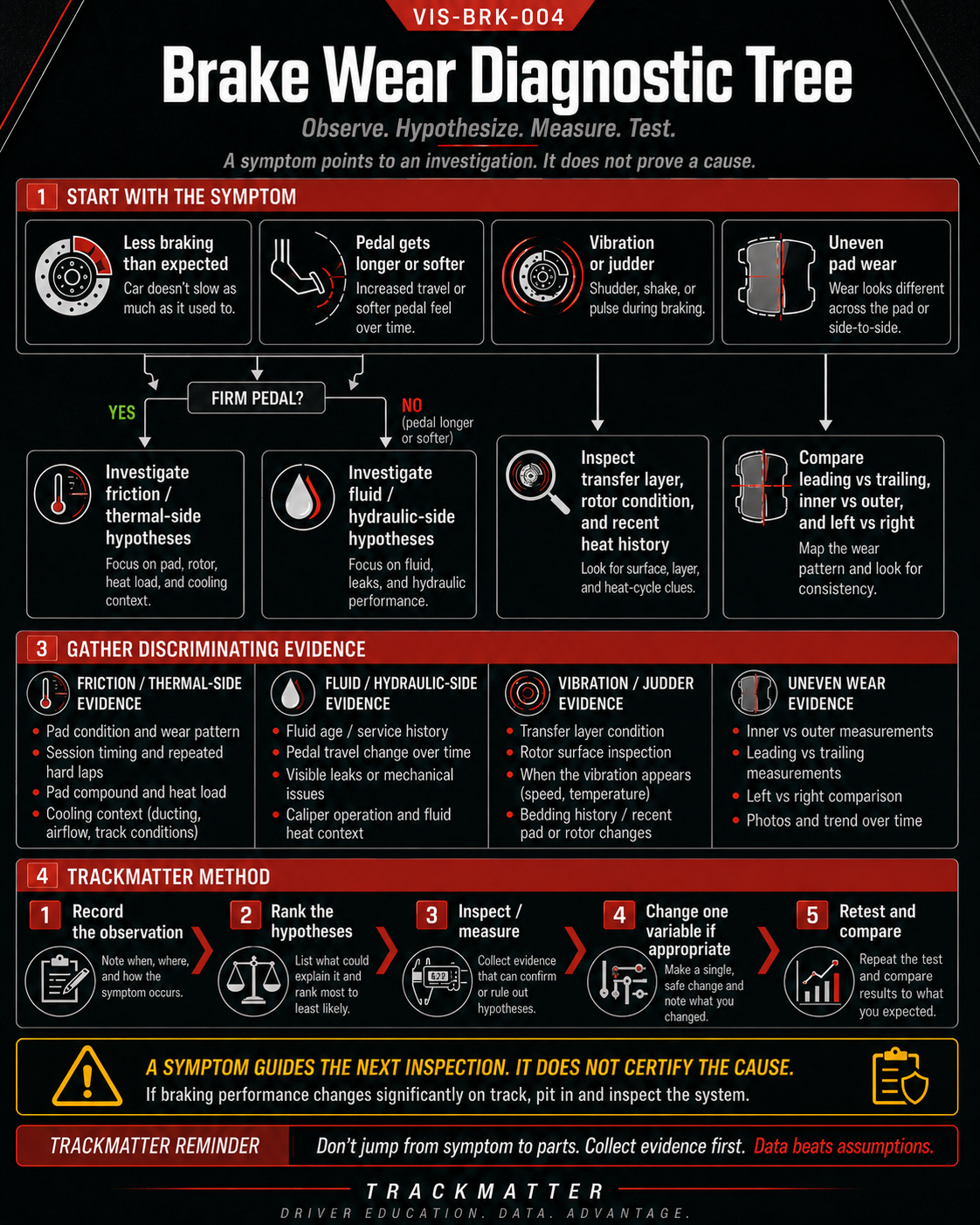
The correct structure is:
Observation → competing mechanisms → discriminating evidence → controlled test
A tapered pad does not automatically mean a seized caliper. A vibration does not automatically mean a warped disc. A firm pedal with weaker deceleration does not automatically prove pad fade.
The discipline is to ask:
What different mechanisms could create what I am seeing, and what evidence would separate them?
Start with the observation
Weak diagnosis starts with labels:
“My brakes are overheating.”
Better diagnosis starts with observable facts:
- braking performance is consistent for the first four laps and then decreases
- pedal travel remains essentially unchanged
- right-front pad loses more material than left-front
- right-front pad shows increasing leading/trailing taper
- steering-wheel vibration appears only after several hard stops
- the condition is absent when cold
The more precise the observation, the fewer stories you need to invent.
Case 1: longitudinal taper
Suppose one end of a pad wears faster than the other.
Possible mechanisms can include:
- the intended leading/trailing load distribution of the caliper
- incorrect caliper orientation or installation
- piston movement problems
- local temperature distribution
- pad/caliper geometry
- track loading and usage pattern
AP Racing and EBC both document the use of staggered/differential piston sizing to manage leading/trailing force and reduce taper. That tells you something important: pressure distribution across the pad is a real engineering problem even in a healthy system.
Your diagnostic questions therefore become:
- Is taper similar left to right?
- Is it similar on inner and outer pads?
- Is the direction of taper consistent with the caliper design?
- Is the rate stable across events or accelerating?
- Is one piston or pad showing evidence of abnormal movement?
- Is the caliper installed/oriented correctly?
- Is there a thermal asymmetry that correlates with the wear?
One photo cannot answer all seven.
Case 2: radial taper
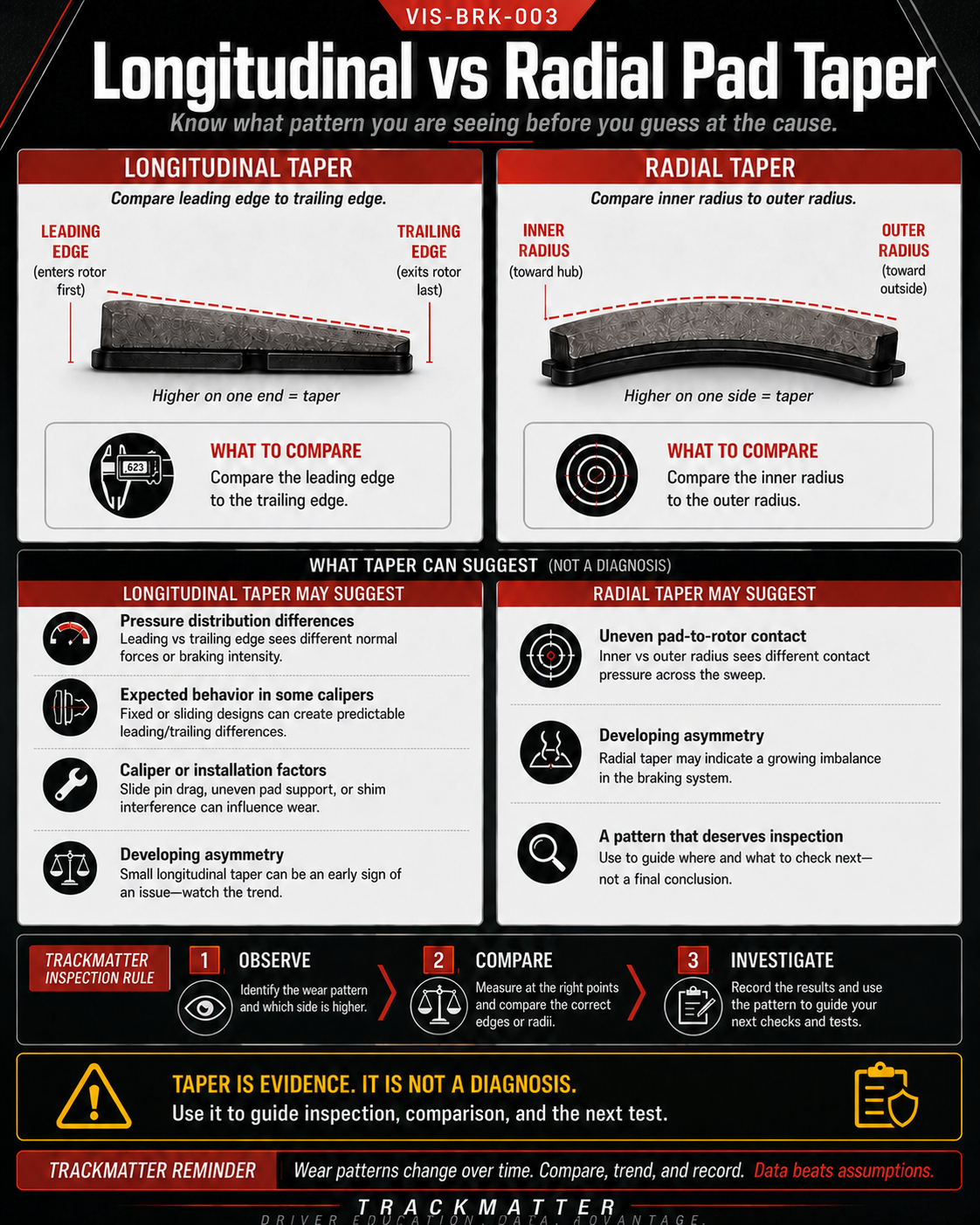
If thickness changes from the inner to outer pad radius, the hypothesis set changes.
Investigate:
- pad sweep and radial depth
- disc/pad alignment
- caliper stiffness and mounting
- disc geometry or condition
- temperature distribution across the disc face
- wear symmetry on the opposite side
A useful Advanced rule is:
Geometry problems require geometric evidence.
If you suspect radial behavior, measure radial behavior. Do not infer it from a single centerline thickness reading.
Case 3: braking becomes worse after several laps
Now pedal feel becomes a discriminator.
Pedal remains firm
Friction-side hypotheses rise in priority:
- pad operating range
- pad/disc interface
- transfer layer
- rotor temperature
- friction-material condition
- total heat demand
PAGID distinguishes pad fade from fluid fade in this way: friction performance can fall while the pedal remains relatively firm.
Pedal becomes long or spongy
Hydraulic-side hypotheses become more important:
- fluid temperature
- absorbed moisture / boiling margin
- air in the system
- another source of hydraulic compliance
- leak or mechanical fault
Brembo explains the underlying vapor-lock mechanism: moisture lowers boiling performance and vapor compresses under pedal force.
These symptoms guide priority. They do not replace physical inspection.
Case 4: vibration after hot sessions
“Warped rotors” is a common shorthand that can hide multiple mechanisms.
PAGID specifically documents uneven friction-material transfer as a cause of brake judder and identifies several ways it can develop, including incomplete bedding, incompatible pad materials and hot stationary imprinting.
That gives you a better hypothesis tree:
Transfer-layer hypothesis Evidence to seek: recent bedding/compound change, temperature dependence, visible deposit pattern.
Disc geometric/runout hypothesis Evidence to seek: correct measurement with appropriate tools and manufacturer criteria.
Mechanical/hub hypothesis Evidence to seek: mounting condition, bearing/hub issues, runout source.
Pad/caliper hypothesis Evidence to seek: abnormal wear, sticking components, inconsistent pad contact.
The point is not to make the tree endless. It is to prevent premature certainty.
Track layout is part of the brake system
A car can behave differently at two circuits without any hardware changing.
Brake demand depends on:
- entry speed
- speed reduction
- frequency of braking events
- spacing between those events
- session length
- available airflow
- ambient conditions
The driver is also a system input.
Two drivers in identical cars can produce different brake temperatures because of braking duration, peak pressure, release behavior, pace and recovery time.
This is why “these pads worked at Track A” is evidence, not proof that they will be appropriate at Track B.
Stability control and ABS can affect the evidence
Modern vehicles can create brake heat that is not solely the result of the driver’s brake-pedal input. Stability and traction systems may selectively apply brakes, and ABS changes pressure during threshold events.
When a wear asymmetry is unexplained, document:
- stability-control mode
- ABS activity
- whether electronic intervention was frequent
- whether the condition is axle- or corner-specific
Do not jump from “electronic systems can use the brakes” to “the electronics caused this wear.” It is simply another candidate mechanism.
Temperature data can help — if you understand what it measures
A pit-lane rotor-temperature reading occurs after the car has stopped doing the braking that generated the heat. AP Racing explicitly notes that rotor temperature decays quickly and therefore treats pyrometer measurements as particularly useful for relative front/rear comparison rather than as a direct peak operating-temperature reading. Thermal paints can preserve evidence that a threshold was crossed during the session.
So ask:
Am I measuring what I think I am measuring?
A precise number taken at the wrong time can be less useful than a coarse measurement that actually answers the question.
Build a discriminating test
Suppose you think right-front pad wear is driven by excess temperature.
A poor test is:
Add ducts, change pads and reduce tire pressure, then see if it feels better.
You changed three variables and learned almost nothing.
A better experiment:
- Keep pad compound, tires, alignment and driving mode fixed.
- Record pad measurements before the session.
- Add or adjust one cooling variable if the system is designed to support it.
- Repeat a representative session under reasonably comparable conditions.
- Record temperature evidence and wear again.
- Compare the result to the original hypothesis.
If the predicted change does not occur, the hypothesis weakens.
That is the Advanced skill: not simply knowing how to modify the car, but knowing how to learn from it.
What not to change yet
Do not automatically:
- install a big brake kit because pads wear quickly
- add maximum cooling because brakes are hot
- choose a more aggressive compound because one session faded
- replace rotors because of any visible surface crack
- rebuild a caliper because a pad has taper
Those interventions may ultimately be correct.
The evidence should earn them.
Apply this to your car
Use TM-AI-014: Diagnose My Brake Wear.
TM-AI-014 / DIAGNOSE
Diagnose My Brake Wear
Use this copyable TrackMatter AI workflow to organize your evidence and next action. It does not inspect the car, certify safety, or replace manufacturer and organizer requirements.
View the structured workflow
ROLE
Act as an evidence-driven track-brake diagnostic assistant. Generate and rank hypotheses; do not provide a definitive remote mechanical diagnosis or declare components safe.

OBJECTIVE
Help me explain an observed brake-wear or brake-behavior pattern and design the next measurements or controlled test that can separate plausible causes.

CONTEXT
Vehicle: [VEHICLE]
Brake hardware: [CALIPERS / ROTORS / LINES / COOLING]
Pad compound: [FRONT / REAR]
Tires: [DETAILS]
Track: [TRACK]
Driver level: [DETAILS]
Session duration / pace: [DETAILS]
Ambient conditions: [DETAILS]
Stability-control mode: [DETAILS]
ABS intervention: [DETAILS / UNKNOWN]
Fluid / service history: [DETAILS]
Pedal behavior: [DETAILS]
Vibration / pull / noise: [DETAILS]
Cooling configuration: [DETAILS]

OBSERVED WEAR
[INSERT MEASUREMENTS BY PAD / CORNER]

TEMPERATURE DATA
[PYROMETER / PAINT / STRIPS / SENSOR DATA / NONE]

IMAGES
[ATTACH]

OPERATING RULES
1. Begin with a precise observation statement, not a cause.
2. Produce multiple plausible hypotheses when the evidence permits them.
3. For every hypothesis, state supporting evidence, contradictory evidence and missing discriminating evidence.
4. Consider driver input, track layout, thermal load, caliper/piston behavior, pad/disc interface, bedding/transfer layer, hydraulic condition, electronic brake intervention and cooling where relevant.
5. Do not universalize manufacturer-specific taper, wear or temperature limits.
6. Do not label every vibration a warped rotor.
7. Do not label every taper pattern a caliper failure.
8. Do not recommend simultaneous changes that prevent learning which variable mattered.
9. Escalate safety-critical conditions to physical inspection.

OUTPUT
1. Observation statement
2. Known / Verified / Unknown
3. Ranked hypothesis table
   - hypothesis
   - supporting evidence
   - contradictory evidence
   - confidence
   - missing evidence
4. Safety-critical possibilities to rule out first
5. Measurements / inspections required next
6. Driver / track-context factors
7. One controlled next-session test, if appropriate
8. Variables to hold constant
9. What result would support each leading hypothesis
10. What result would weaken each leading hypothesis
11. What not to change yet
12. Physical inspection / stop-driving triggers
13. TrackMatter next step
SOURCES & TECHNICAL REFERENCES
Sources behind this lesson
These manufacturer and organizer references support the technical principles used here. Product-specific guidance applies only to the named manufacturer, component, or event context.
- BremboBrake Fluid Solutions for Cars
Brake-fluid moisture, boiling-point degradation and vapor lock
- PAGID RacingTechnical Advice
Judder, transfer layers, hot imprinting, pad fade vs fluid fade and pad heat capacity
- PAGID RacingTechnical Information
Bedding purpose and manufacturer-specific procedure
- AP RacingDisc Temperatures
Measurement limits, thermal stability and overcooling warning
- AP RacingMeasuring Brake Temperature
Brake-temperature measurement methods
- AP RacingStandard Brake Caliper Features
Differential bores and piston positioning used to combat taper
- AP RacingSafety & Care of Discs
Heat crazing and product-specific crack guidance
- EBC RacingBrake Pad Tapered Wear and How to Avoid or Correct It
Leading/trailing taper, piston sizing and possible mechanical causes
- Essex Parts ServicesTrack and Racing Brake Pad Owner's Guide
Transfer layers, wear behavior and systematic inspection
- Brembo RacingRacing Catalogue — Installation and Use
Product-specific pad wear and abnormal-taper criteria